The field of war reporting has really changed over the last few years. As I’m filming this, the Iraqi government is fighting ISIS for control of the city of Mosul. The battle has been dragging on for many weeks. And throughout the fighting, reporters are actually embedded with front-line combat units, not just reporting from far off. They are definitely in harm’s way. But that means they are also seeing war for what it really is – terrifying, stressful, nothing like the movies.
One of the tidbits that has stuck with me recently is the sound – the sound of bullets striking the armor of the vehicle they’re in. And more terrifying – the sound of bombs crumpling part of the protective shell or destroying the wheels, leaving them as sitting ducks. And that stuck with me, because it highlights that you can get hurt even if the armor works. You can go deaf, you can get tossed about and injured, even if the armor works.
It’s kind of like those giant padded sumo wrestling suits – ever worn one of those? They are a fan favorite at youth group, because they let you fight with no risk of injury. Who could get hurt with all that padding, all that armor? Well, that’s what I thought, too, right up until the moment when one of the kids fell awkwardly in the suit and broke his arm. You can still get injured, even with all that padding, all that armor.
In Ephesians 6, we see how badly we need the whole armor of God. We need to protect our minds, protect our bodies, protect our hearts and souls. But like the armored vehicle transporting the war reporters, like the copious padding of the sumo wrestling suit, we can still get hurt by whatever life is throwing our way. We can survive anything thanks to the armor of God, but don’t be surprised when it still hurts.
As you read chapter 6, remember that Christians aren’t supposed to just float above the cares and concerns of life – we are supposed to be right there in the thick of it, so we’re going to take some hits. When have you been hurt, but kept your faith thanks to the armor of God? Enjoy chapter 6.
"Sola 5: Scripture Alone" by Rev. Cody Sandahl - January 29, 2017
/
RSS Feed
Share
Link
Embed
Introduction
We are coming up on the 500th anniversary of the Reformation, where Christianity had to take a long, hard look at itself and figure out where it needed to get back to the core message of Jesus. We, as Presbyterians, are part of that 500-year-old experiment.
During the Reformation, there were five slogans used to capture how the Reformers differed from the Catholic Church at the time. There were five things they thought needed to be focused on. Five ways the church needed to go back to the basics instead of adding stuff on.
These were the five “sola’s”, which is Latin for “alone.” Today we’re looking at the slogan, “sola scriptura,” or “Scripture Alone!”
Matthew 5:17-18
17“Do not think that I have come to abolish the law or the prophets; I have come not to abolish but to fulfill. 18For truly I tell you, until heaven and earth pass away, not one letter, not one stroke of a letter, will pass from the law until all is accomplished.
Hebrews 4:12
12Indeed, the word of God is living and active, sharper than any two-edged sword, piercing until it divides soul from spirit, joints from marrow; it is able to judge the thoughts and intentions of the heart.
Who’s Right?
Here’s a quick question for you. What color is the carpet in this sanctuary? What would you call that color? I heard a few say “pink.” But you’re wrong. I say that color is weathered salmon, and there’s nothing you can say to convince me otherwise. Do you know how I know I’m right? Because I have a microphone and you don’t. Case closed.
Is that a good way to settle arguments? Based on who’s loudest? Or who has the better title in front of their name? Maybe we should decide it based on who’s taller. Or my preferred method: feats of strength like rock tossing.
When we have disagreements in the church, how do we settle those? When I say we need to go left to be faithful to Jesus, and you say that we need to go right to be faithful to Jesus, how do we know who’s correct?
Scripture vs Church
Every generation has its theological debates. We have our own. But the debates 500 years ago at the time of the Reformation were a little special, because they weren’t just about content. They were about process. They didn’t just debate their problems, they debated HOW to solve problems. And that still applies 500 years later.
There were two basic sides in this debate. In one corner you had the Catholic Church, which at the time was THE church in Europe. And they said that the Church in general, and the Pope in particular, had the authority to decide what was right.
In the other corner you had the Reformers, who said that you could only discover what was right by studying Scripture.
So you have Scripture Alone versus Scripture AND the Church’s teachings. That may sound like splitting hairs, but after 1500 years, the Church had accumulated some strange teachings that weren’t in the Bible.
The biggest problem, according to the Reformers, was the sale of Indulgences. They were a bit complicated theologically, but in effect they allowed you to buy forgiveness from the Church instead of having to actually change your heart or change your life in any way. If you weren’t good enough to follow Jesus, you could just buy your Christian membership card instead. No sweat.
And they turned out to be great fundraisers. In fact St. Peter’s Basilica was built with the sale of these indulgences across Europe. But that rose the ire of many, including the original Reformer Martin Luther, who wrote, “Why does not the pope, whose wealth today is greater than the wealth of the richest Crassus, build the basilica of St. Peter with his own money rather than with the money of poor believers?” That’s how theologians do smack talk, by the way.
And as Luther considered the injustice of these indulgences, and as he considered the way the church was justifying their sale and use, he decided that the Church couldn’t just make up stuff that wasn’t in the Bible. The Bible ALONE was the source of knowledge about who God is, as revealed in Jesus Christ. Nothing outside of that should be allowed.
Hot Button Theology
Let me bring this into today. Later this year I’m going to lead a class where we discuss hot button theology together. So, for example, when we talk about guns, we’ll see that God is depicted as wielding a sword, that Jesus made his disciples get a few swords before he was betrayed, BUT we also see that at the end of time swords are turned into plows, and when Jesus was betrayed he didn’t want his followers to use those swords.
So when we say Scripture Alone, that means our answer to things like gun ownership, the use of force in self-defence, or is it morally OK to kill while in the military, those answers should be shaped by what the Bible says, not just the family you grew up in, not just your personal experiences, not just your personal opinions. It is very rare for us to actually do this. Usually we find a couple of Bible verses that support our existing opinion and ignore the rest. But that’s not what the Reformers were about.
And our text from Hebrews today, does this sound like the Bible should just confirm whatever you already believe: “the word of God is living and active, sharper than any two-edged sword, piercing until it divides soul from spirit, joints from marrow; it is able to judge the thoughts and intentions of the heart.” That doesn’t sound like a rubber stamp to me. That sounds like the Bible is meant to challenge us. It is meant to change our thoughts. It is meant to shape our hearts.
Expectations
So before the Reformation, Christians were expected to attend church regularly, feel guilty, and hopefully buy their way out of a few sins. Pretty easy. But AFTER the Reformation Christians were expected to start reading the Bible for themselves. To start understanding Scripture on their own, not just taking the priest’s word for it. This seems like a downgrade to me. It means I have less authority and you have more work to do. We both lost in this, right?
Well here are two possible challenges for you. As Presbyterians, we believe that we know who God is through Scripture Alone. Nothing else has ultimate authority. The Bible outranks our thoughts, outranks our emotions, outranks our culture, outranks our history, outranks everything else. That’s what Scripture Alone means.
So how well do you know it? If it is the source of truth, if it reveals who God truly is, if it is the way you know God’s will for your life, how often are you reading it on your own? If you are praying for God to give you guidance right now, are you reading what he already told us? If you are debating a major decision, are you checking with the words of the creator of the universe?
It may sound strange, but if you commit to reading what God has already said, I guarantee he will say things to you personally. This is the primary way God reaches into your life. But it takes your time. If you want guidance from God, this is how you get it. If you don’t know what to read, search for a reading plan or devotional online. I use something called the Life Journal reading plan. Or just read the parts near where our sermon is. Or just go through the Gospel of Mark. Start somewhere. Over time, God will speak to you.
Commit to reading the Bible regularly – that’s the first challenge.
But let me pause here and tell you about my experience reading Scripture regularly. I have always had a problem with Bible reading plans: I am a perfectionist. So every time I start a reading plan, I start with gusto, reading every assigned chapter. But then I miss a day or two, and I feel like I have to go back and read what I missed so that every box is checked, every “I” is dotted, every “T” is crossed. And eventually that overwhelmed me every single time, and so I would stop reading at all for a while.
All that changed when I went to the Hawaii Leadership Practicum, and the leader, Wayne Cordeiro, asked me what I was trying to prove with that. He said, “Will Jesus love you more because you read all five chapters instead of just one? Will Jesus love you less because you skipped a day or two?” Of course not! If you miss a few days, you miss a few days. Just skip them. And if you read a few verses and find that you have an insight or a word from God, stop there! You don’t have to keep reading just to keep reading. God already spoke to you! Stop trying to earn God’s love through your commitment to your Bible reading plan.
That’s what I needed to hear. And it has kept me regularly reading Scripture and journaling since 2012. Before that I had never made it more than a few months of journaling. And if you look at my journal entries, there are gaps. There’s a one month gap in there. There’s a two month gap in there. There’s a THREE month gap in there. But I kept coming back. And I didn’t do three months’ worth of reading when I came back, I just picked up on the right day and kept going. If you take up the challenge to read your Bible and reflect on it regularly, don’t try to show Jesus how committed you are. Just take it as it comes. If you skip a day, you skip a day. Just keep coming back. That’s more important to you and to Jesus than checking all the boxes on the reading list.
Challenging Beliefs
If you’re already doing that, here’s another challenge. Take something you care about deeply. Something where you have a strong opinion about what’s right. Maybe that’s about the right way to live. Or something in our society. Or something to do with social justice. Something you care about.
Do you know what the Bible says about that? You may know a few verses that AGREE with you, but are there any other Bible verses that put a different spin on it? How would you even find out what the Bible says about it?
For those who attended my class on Understanding the Bible, they already know what I’m about to say. Because I showed them how to use the most powerful Bible study tool ever invented. A tool that most of you already know how to use. I speak, of course, of Google.
Here’s your challenge. Go to Google and type in “what does the Bible say about …” and put your topic in there. In the first few hits you’re just about guaranteed to get a few articles that give someone else’s opinion, and then you’ll see something from openbible.info. And that site is just a list of all the Bible verses about that topic – no more thoughts than that. It’s a great reference! If you know how to turn on a computer, go to the web browser, and type in “what does the Bible say about …”, then you have no excuse for not knowing what the Bible says about a topic that you care about.
Give it a shot. If you have trouble figuring out what the Bible MEANS when you read what it says, that’s fair enough. That’s where I can help, or a Bible study can help, or talking to respected friends can help. But it only takes a few seconds to find out what the Bible says about a topic. No excuses in the 21st century.
Summary
Sisters and brothers, we believe that the Bible is THE way that God reveals who he is. If this were the Olympics, the Bible would have the gold, silver, and bronze medals. Every other way of knowing who God is can’t even make the podium.
If you want to hear from God, read what he has already said. Reading the Bible is the primary way that God speaks to us today. If you want guidance, read the Bible. If you want clarity, read the Bible. If you want direction, read the Bible. God will speak. No guarantees on whether you’ll like what you hear, but God will speak. Sometimes it even takes a while, but God will speak.
"The Least and the Lost" by Rev. Cody Sandahl - January 15, 2017
/
RSS Feed
Share
Link
Embed
Introduction
This week I want to look at something that is very relevant to our church – how should we interact with the least and the lost? When someone in our community is in need, what should we do as a church and what should we do as individuals? When someone who has had a hard life comes to our door, what should we do?
This is relevant now ESPECIALLY because of what we’ve seen since we started the free community dinner. We have been very intentional about making the community dinner focused. It’s designed for the hungry and the lonely in our community – not just for people with no home and no money, it might be someone who barely has a home or they’re in school or they’re barely making ends meet. And it’s designed to communicate value – real plates for real people, not disposable plates for disposable people. And finally it’s designed to be personal – someone is at the table to talk with you.
Notice what I DIDN’T say – evangelism isn’t a part of this free meal. In fact, when Lynda talked with other churches who do this they shared that trying to evangelize will scare everyone off. This meal is about feeding people, helping them feel valued, and providing conversation and relationships.
But after doing that a few times, after we gained a reputation as a safe place to go, guess what happened? Word started spreading. And we have especially seen an uptick in our weekly interactions with the homeless and those who are barely surviving in our community. The least and the lost are coming to our doors more frequently, because we are seen as a place that is safer and kinder than most.
That’s great! But it brings some challenges. When you see a homeless guy out in front of our church, what crosses your mind? Does that make you glad, because we’re making an impact in our community? Or does it make you worried for your own safety? When you hear that we’re helping more people, does that make you glad, or does it make you worried that we’re enabling people or being taken advantage of? How do we help the least and the lost, while also keeping this a safe and effective place for worship and the ministries we do for you, the congregation? I think these are questions worth considering together.
I wanted to pair something from the Old Testament with our New Testament reading we just heard, so here is what God told the Israelites in Deuteronomy 15.
Deuteronomy 15:7-11
7If there is among you anyone in need, a member of your community in any of your towns within the land that the Lord your God is giving you, do not be hard-hearted or tight-fisted toward your needy neighbor. 8You should rather open your hand, willingly lending enough to meet the need, whatever it may be. 9Be careful that you do not entertain a mean thought, thinking, “The seventh year, the year of remission, is near,” and therefore view your needy neighbor with hostility and give nothing; your neighbor might cry to the Lord against you, and you would incur guilt.10Give liberally and be ungrudging when you do so, for on this account the Lord your God will bless you in all your work and in all that you undertake. 11Since there will never cease to be some in need on the earth, I therefore command you, “Open your hand to the poor and needy neighbor in your land.”
Am I Supposed to Help?
Pop quiz – what was the main point of last week’s sermon? Don’t panic if you can’t remember, no one else remembers either. That’s the pastor’s life for you. By the way, it was an encouragement to “persevere” as you walk down the road you’ve chosen or the road you’re forced to walk down.
Given how quickly sermons fade from memory, I am usually quite enthused to hear when someone puts a sermon into practice. But one time I was a wee bit concerned, actually. It was in my previous church, and a woman told me that a sermon I gave on interacting with the homeless people around us had stuck with her. And she had passed by a homeless man on the road who was walking somewhere. And she said, “I didn’t want to, but your sermon made me pull over and offer him a ride.”
Now part of me was very proud of her to take such a step in her faith. But another part of me was concerned, because it’s probably not a good idea to ALWAYS pull over and offer someone a ride. That could be dangerous. Especially if you’re next to one of those signs that says, “Prison – Do not pick up hitchhikers.” And that got me thinking – how do we exercise both wisdom AND compassion?
I mean, Jesus says in Matthew 5, “Give to those who ask, and don’t turn away from those who want to borrow.” Does that mean that I need to have cash ready for everyone who’s begging at a street corner? If someone comes in from the community and they need three month’s rent to stay in their house, do I need to find a way to pay for that?
In other words, “when am I supposed to help?” Isn’t that really the question at the core of this? “When am I supposed to help?” Do you want to know how to answer that?
Let me tell you how I discovered the answer to that question in my life.
It was many years ago, and I think it was like a Good Friday service or something pretty somber like that. And during a time of silence a guy from the street came into the church, stumbled toward the front. A voice inside told me, “Go to him.” But I stayed in my pew. The man collapsed on the front steps, and stretched his arms out toward the cross, and again the voice said, “Go to him.” But I stayed in my pew. He broke down weeping at the front of the church, and I again felt the direction to go to him. But I stayed in my pew. Finally, someone else got up and went to him, and several people surrounded him with prayer. God found a way to help without me. But I was supposed to help. And I didn’t. That still haunts me.
But that’s when I decided that there’s an easy answer to the question, “should I help?” The answer comes in the form of another question: “has the Holy Spirit told you to help?” At that Good Friday worship service, there were several hundred people. If everyone wanted to help, it would have been impossible. But there were SOME people there who were supposed to help. And luckily some of them listened better than I did.
When I pass by someone begging on the street, I direct the question to God: “should I help?” Sometimes I get a “yes” back, and sometimes I get a “no” back. Now here’s a pro tip: if you always think you get a “no” as your answer, you might not really be hearing from God.
So if you’re wondering if you should help, ask God to tell you. Sometimes he wants you to help this particular person and sometimes he has other people lined up to do it. Ask the Holy Spirit to tell you.
How Should I Help?
So let’s suppose you get a “YES” back from God. You’re supposed to help this person this time. The next question is, “how should I help?”
I mean, Jesus says to give to those who ask, but he doesn’t say you have to give exactly what they’re asking for. Can you give food instead of money? Can you give conversation and a little time? Is there a way to help that you’re comfortable with, even if it’s not exactly what they’re asking for? If you don’t want to give money, can you have power bars in your car? If you don’t want to help one-on-one, can you give to a ministry or an organization that helps?
And here’s the interesting thing, I asked three of the people we see pretty regularly what they would want us to know about helping them. And they had three different answers. One said he wanted to be treated like a person more than anything else. Conversation, respect, kindness, honesty – that’s more valuable than anything else. But another one said that he didn’t want to talk until he knew that he was being taken care of – he’s a little more transactional. And the third was totally different – he said he wanted to know WHY we’re helping – our beliefs, our faith.
So the answer to “how should I help” I think depends on the person. And that, of course, requires getting to know the person a little bit. That doesn’t really apply to a one-time gift on a street corner, but it sure does here at the church.
What About My Safety, or My Family, or My Church?
I think there is one final question to ask. “What about me?”
If it’s getting dark, and you’re coming to a meeting at the church, and you’re the first to arrive, and you see someone pacing by the front door of the church, you might be wondering if it’s safe for you to get out of your car.
Or looking at it from another angle, if you hear that we’re providing food for the hungry and we help someone out who needs gas because they sleep in their car and use it for heat, maybe you’re thinking that you have problems, too. Why are we helping them and not you? Why are we helping them and not your friend in the other pew who can’t pay the rent this month?
Jesus talks about this, too. He says other people will know we are his disciples if we have love for one another. When the early church started, they gave to take care of any needs in their church. The early churches had dedicated people to help take care of those needs, and they called them deacons. And we have the same thing. Our Deacons exist to help the member who can’t pay their rent, or the regular attender who is running out of food, or the person who is sick in the hospital or alone at home. That’s what they do. So when we help someone from the community, we aren’t taking anything away from what we do to help those inside our church.
Now I will admit that safety is a valid concern. You need to feel safe coming into the building. We’re trying to walk a fine line in being welcoming to the community AND a safe place for people of all ages and experiences. We have elementary school kids coming here, we have women who have experienced abuse coming here, we have widows who are coming here alone, we have to take that into account. But I don’t believe Jesus would turn someone away for that reason alone. How can we do both? How can we be a safe place for wounded people AND a welcoming place for people in need? I don’t have a quick answer to that, but that’s what I’m shooting for.
Summary
Sisters and brothers, we heard in our two texts today – in both Old and New Testaments – that God wants us to help the hungry, the thirsty, the lonely, the sick, the prisoners. But God also wants us to help the other people in these pews. We cannot say “no” every time. Part of being Christian is saying “yes” to helping.
If you’re wondering, “am I supposed to help,” ask the Holy Spirit to tell you. But if you get a “no” back every time, you’re probably asking yourself rather than the Holy Spirit. God says “yes” pretty frequently.
If you’re wondering, “how should I help,” try to find something you’re comfortable with AND that meets the other person’s needs. If it’s one of the people we see repeatedly around here, try to get to know them.
Finally, if you’re wondering, “what about me,” or “what about my friend sitting next to me,” remember that we are trying to be a place for safe and effective ministry AND a place that welcomes the hungry and the lonely. We are trying to help you, the friend sitting next to you, AND the person from our community who has nowhere else to go.
We are GOING to see more and more people from our community. And some of them aren’t going to be clean-cut. Some of them aren’t going to be well-groomed. Some of them aren’t even going to have homes. I think that means we’re following in Jesus’ footsteps. But it also brings a few challenges. I hope you are on board. I hope your heart and your mind are willing to engage. Because we can’t do this without you.
"On the Road" by Rev. Cody Sandahl - January 8, 2017
/
RSS Feed
Share
Link
Embed
Introduction
Well we’re closing the door on the Christmas season today. Today we’re looking at two different texts. We just heard about Jesus’ baptism, which really marked the beginning of his ministry. And our other text today is the last part of the story of Jesus’ birth – the coming of the wise men from the East.
Matthew 2:1-12
1In the time of King Herod, after Jesus was born in Bethlehem of Judea, wise men from the East came to Jerusalem, 2asking, “Where is the child who has been born king of the Jews? For we observed his star at its rising, and have come to pay him homage.” 3When King Herod heard this, he was frightened, and all Jerusalem with him; 4and calling together all the chief priests and scribes of the people, he inquired of them where the Messiah was to be born. 5They told him, “In Bethlehem of Judea; for so it has been written by the prophet: 6‘And you, Bethlehem, in the land of Judah, are by no means least among the rulers of Judah; for from you shall come a ruler who is to shepherd my people Israel.’” 7Then Herod secretly called for the wise men and learned from them the exact time when the star had appeared. 8Then he sent them to Bethlehem, saying, “Go and search diligently for the child; and when you have found him, bring me word so that I may also go and pay him homage.”
9When they had heard the king, they set out; and there, ahead of them, went the star that they had seen at its rising, until it stopped over the place where the child was. 10When they saw that the star had stopped, they were overwhelmed with joy. 11On entering the house, they saw the child with Mary his mother; and they knelt down and paid him homage. Then, opening their treasure chests, they offered him gifts of gold, frankincense, and myrrh. 12And having been warned in a dream not to return to Herod, they left for their own country by another road.
It Takes Time
Here’s a trivia question for you. You might know the answer. When did the United States become an independent country? Any guesses?
Well it turns out, that’s a difficult question to answer. Perhaps you like July 4, 1776. The Declaration of Independence. That’s fine, but the Revolutionary War didn’t see its last battle until the Siege of Yorktown on September 28, 1781. But then there’s the Treaty of Paris, in which Britain formally recognized our independence. That was signed on September 3, 1783. But, of course, it wasn’t ratified until January 14, 1784. A simple question, but one with four different answers spanning seven years.
Here’s another way to look at that. July 4, 1776 – that’s when it was DECIDED to seek independence from Britain. And it took five more years of war and then two extra years of diplomacy to get there.
Similarly, the wise men from the East came to Jerusalem, asking about the birth of the new king. But notice that the text doesn’t call Jesus a baby. He was a baby in the last chapter talking about his birth. Now he’s a child. He’s a toddler, not a baby. The wise men saw the star when Jesus was born. That’s when they DECIDED to visit this new king. It just took two years to get there. And then they had to ask for directions. And then they still had to find the family. Not exactly instant feedback.
And then, they’re not even done after they delivered the gifts. Our text says they were warned in a dream to avoid Herod, so they had to find a new way home. That means it took them about four years from DECISION to COMPLETION of their task.
It reminds me of a story that Donald Miller told in his book A Million Miles in a Thousand Years. He decided to paddle across a large lake up in the Northwest, and he was excited as he set out on this adventure. He felt like he was making good time as he paddled away from the shore. Every stroke took him noticeably further from his starting point. But as he reached the middle of the large lake, he started wondering if he was still making any progress. He kept paddling, but he couldn’t see the shore behind him, and he couldn’t see the sands of his destination, either. He seemed to just be paddling without going anywhere. But he persisted. And eventually, the distant shore came into view. It started growing larger. And every stroke took him visibly closer to his goal. His journey was exciting in the beginning because he could see how far he had come. It was exciting at the end as he could see the finish line. But in the middle? It was depressing, anxious, deflating, defeating.
Have you ever had to face a long journey? A difficult path between DECISION and COMPLETION? Fought a long-term illness? Tried to change the dynamics of your marriage? Tried to work your way up the career ladder?
Perseverance
All of these things share one thing in common – they require perseverance. It took perseverance for the wise men to travel two years each direction to give gifts to a foreign king. It took perseverance for the Founding Fathers to win independence from Britain. It took perseverance to paddle across the large lake. Where do you need perseverance?
Many years ago I helped start a church in Austin, and we had small groups that met every week. And the pastor and I tried to have something tangible and impactful each week in the small groups. We wanted people to make the tough decision to let Jesus be lord of every part of their life. But one of the guys in my group complained to me – not because it was too challenging, not because he resisted the commitments required. He complained because he wanted to do ALL of it. He complained that he couldn’t make major life transformations every single week. Some of those changes took time. He needed to focus on one thing until he had it down pat, not make a new major decision every week. He needed time and space to persevere, not a new thing to change and distract him from the decision a week before.
And so this Sunday I’m not going to try to give you some new insight. I’m not going to try to convince you to make a new decision in your life or your faith. I’m just asking – where do you need perseverance? What decision have you made, but you haven’t reached completion yet? Where have you signed the Declaration but still need to fight the war or sign the Treaty? Where do you need conviction rather than convincing?
Maybe that’s a task – like the wise men traveling across the desert. Maybe that’s hope in the midst of despair – sometimes hope is a choice more than a feeling. Maybe that’s keeping a new attitude. Where do you need perseverance? Where do you need the courage to keep walking down the road you already chose to walk down? Or even the road you’re forced to walk down?
Baptism
Maybe it’s worth recognizing that we’re eight days into the New Year, and many of you probably made a resolution just a short while ago. Of course, many of you have already abandoned those same resolutions already. According to a recent survey, only 9% of people actually achieve their New Year’s Resolution each year. If you need perseverance because you haven’t had it so far, well I don’t know if you’re in good company but you’re in a lot of company at least.
But I find two things comforting. First, although only 9% of people achieve their resolutions, the act of explicitly writing down your goal and what you’re going to do about it makes you ten times more likely to do it than if you don’t write it down explicitly. Making A DECISION is better than making NO DECISION.
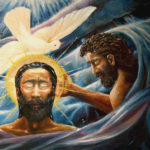
And the other thing that’s comforting to me is the first text we ready today – the baptism of Jesus. Because Jesus had made some important decisions. He decided to come down, be born, and live with us. He had been preparing for his public ministry for thirty years. And then he decided to be baptized. That moment marked the beginning of a three-year journey that would culminate in the cross. And knowing where this was all heading, I find it comforting that Jesus needed the reinforcement from the Spirit descending like a dove and the voice from heaven, “This is my Son, the Beloved, with whom I am well pleased.”
I find that comforting, because it means that when I’m feeling hopeless in the middle of the lake, when I’m feeling like I need a pick-me-up to keep going, when I’m feeling like I need a little reinforcement that I’m on the right road, well that’s what Jesus needed from the Spirit and from the Father at his baptism. If you’ve been walking a tough road and you’re feeling down and wondering if you’re doing the right thing, there’s nothing wrong with you – we’re all like that when we’re on a long journey. If you’re feeling a little defeated but you still think you need to persevere, pray to God for that confirmation, that reinforcement.
What would that look like? How could God show you in some small way that he’s with you and you’re on the right path? How could God show you that you are, in fact, on the wrong path? What would that prayer be for you?
Summary
Sisters and brothers, sometimes we don’t need new information or fresh insight. Sometimes we just need perseverance to walk the road we’re already traveling. Sometimes we just need the courage to stick with what we’ve already decided, or to endure what we’re forced to face. If you’re feeling like the wind is out of your sails, if you’re feeling like you need a little reinforcement from God, remember that Jesus needed that at his baptism, too. And the wise men, walking for two years across the desert, they needed the guidance of that star.
My prayer for all of us is that we have the strength and courage to endure. To persevere. Even in the middle of the desert. Even in the middle of the lake. Keep walking the road. Keep paddling toward the distant shore. For you are God’s son or daughter, you are beloved, and with you God is well pleased. Amen.
"A Sight to Behold: Seeing Jesus" by Rev. Cody Sandahl - Christmas Eve, 2016
/
RSS Feed
Share
Link
Embed
Luke 2:1-20 (KJV)
In those days a decree went out from Emperor Augustus that all the world should be registered. 2This was the first registration and was taken while Quirinius was governor of Syria. 3All went to their own towns to be registered. 4Joseph also went from the town of Nazareth in Galilee to Judea, to the city of David called Bethlehem, because he was descended from the house and family of David. 5He went to be registered with Mary, to whom he was engaged and who was expecting a child.6While they were there, the time came for her to deliver her child. 7And she gave birth to her firstborn son and wrapped him in bands of cloth, and laid him in a manger, because there was no place for them in the inn.
8In that region there were shepherds living in the fields, keeping watch over their flock by night. 9Then an angel of the Lord stood before them, and the glory of the Lord shone around them, and they were terrified.10But the angel said to them, “Do not be afraid; for see—I am bringing you good news of great joy for all the people: 11to you is born this day in the city of David a Savior, who is the Messiah, the Lord. 12This will be a sign for you: you will find a child wrapped in bands of cloth and lying in a manger.” 13And suddenly there was with the angel a multitude of the heavenly host, praising God and saying, 14“Glory to God in the highest heaven, and on earth peace among those whom he favors!” 15When the angels had left them and gone into heaven, the shepherds said to one another, “Let us go now to Bethlehem and see this thing that has taken place, which the Lord has made known to us.” 16So they went with haste and found Mary and Joseph, and the child lying in the manger. 17When they saw this, they made known what had been told them about this child; 18and all who heard it were amazed at what the shepherds told them. 19But Mary treasured all these words and pondered them in her heart. 20The shepherds returned, glorifying and praising God for all they had heard and seen, as it had been told them.
Seeing Things Differently
Well this whole month of Advent we have been noticing how people see things differently in the build-up to Christmas, and today people get to see Jesus himself. And it reminds me of a day that is etched in my memory for ever. A day when I realized that everything had changed. A day when even my definition of “fun” was altered forever. October 12, 2011. It may not have significance for you, but it means a great deal to me. Any guess what happened on that date?
For those of you who know that I have a five-year-old son, you might think that’s his birthday, and you’d be barking up the right tree, but no. That’s four weeks after his birthday. You see, when babies are born, they are often very tired from the trauma of birth. You might get a week or two of glorious bliss where you THINK you have a relaxed, chill baby. Fat chance. That just means they’re rested up and ready to rock and roll after that. And so on October 12, after two weeks of sleepy baby, now my wife and I had two weeks of not so sleepy baby. My perspective was beginning to change.
Now, there’s another thing you should know. I am a night owl. I once stayed up several days in a row just to see how long I could make it. On my extended breaks in college I would switch to a nocturnal schedule because I preferred to work at night. I used to write articles and make animations for a humor website, and 3am was when the magic happened. I LOVED staying up late. It was so much fun!
But now, on October 12, I wasn’t loving it anymore. There’s a big difference between choosing to stay up late and being forced to stay up late by a screaming parcel of humanity. Out of all the words to describe that experience, one word I would definitely NOT choose is “fun.” And so ever since October 12, 2011, I have seen 3am very differently than I did before my first child.
Seeing Family Through God’s Eyes
Seeing and experiencing my first child changed the way I see my family.
And I bet Mary and Joseph were starting to see their family differently once they saw the baby Jesus. There is a natural sense of responsibility that comes upon you when have a child, but imagine if you were tasked with caring for a future king, or a future president, or, you know, the Son of God. That probably felt a mite intimidating.
I think, finally seeing Jesus, they started to see their family differently. They saw each other differently.
As we near Christmas, as we remember the birth of Jesus, is there any way that God wants you to see YOUR family differently? One of our readings today called Jesus “Wonderful Counselor, Mighty God, Everlasting Father, Prince of Peace.” So remembering that the Prince of Peace is born, is there a way that he wants you to find peace in your family? Does Jesus want you to see your spouse in a new light? To parent in a manner that reflects the Everlasting Father? How might you see your family through God’s eyes this Christmas?
Seeing the Outcasts Through God’s Eyes
But, you know, the story of Christmas isn’t just about a family. It’s much bigger than that. After all, who gets to hear the announcement of Jesus’ birth from an angel? Shepherds. And shepherds weren’t exactly well-regarded at the time. They were considered untrustworthy – so much so that a shepherd couldn’t give testimony in court. They were assumed to be liars. Their work with the animals meant they were often considered “impure” and so were barred from entering the Temple. These particular shepherds had to live with a certain irony – they were caring for the animals that would be sacrificed at the Temple, but the act of caring for the animals made the shepherds unable to attend that same Temple. It would be like telling the people who clean our church that they aren’t welcome in worship because the act of cleaning made them look too dirty. That would be crazy. Shepherds were used and cast aside – they were outcasts.
I gained a newfound respect for shepherds after my experiences in rural Texas. I once dated a girl who had sheep and goats, and she invited me into the pen to meet her favorite goat. Male goat – key to the story. As I entered the pen, the goat immediately was perturbed at my presence. So he shook all over, lowered his head – and remember, male goat, so…horns – and charged at me in the confined space. Luckily I managed to grab his horns and toss him onto his back, which gave me enough time to effect a strategic retreat outside the fence, never to return again. Anyone who can work with those animals has my respect. Hats off to them.
But let’s think through this. Mary gives birth in a crowded stable. Now I don’t know about your experience, but after my wife gave birth she wasn’t too keen to have visitors immediately. Let alone a bunch of shepherds, who probably had their sheep with them. If I were Mary, I’d be like, “God, you made people look at me weird due to this miraculous pregnancy. Then you made me give birth in a stable. Then you sent a bunch of SHEPHERDS right after I gave birth! Seriously God?!? Is it April Fool’s Day in heaven or something?”
Now we don’t have a lot of shepherds running around anymore, but who are the outcasts today? Who is looked down on today? What if a bunch of homeless men and women came in right after you or your spouse gave birth? What if a mental health center brought a busload of mentally ill people over for dinner?
The story of Christmas features the poor and the outcast prominently. While kings and priests are sleeping unaware, the poor and the outcast get the news personally from an angel. While the powerful and respected are looking after their own concerns, the poor and the outcast are leaping for joy at the birth of the true king. Does Jesus want you to see the poor and the outcast through God’s eyes this Christmas? Who are the shepherds of today? How might God want you to see them differently as a result of the Christmas story?
Seeing Life’s Blessings Through God’s Eyes
I think those shepherds show us something else, too. Imagine that I told you that this Christmas, you get to spend the whole day outside in the cold. And while you’re outside you’re working a double-shift, no holiday for you. If that were the case for you tomorrow, would you be celebrating or complaining?
That’s what the shepherds had in store for them. They had hundreds of reasons to complain. But how does our text end? “20The shepherds returned, glorifying and praising God for all they had heard and seen, as it had been told them.” They’re celebrating! They’re praising God! And they’re telling everyone who will listen this good news!
Despite their plethora of reasons to complain, they celebrate the one piece of big, great news they have. They see the blessing they’ve received from God, not just the thousands of imperfections and annoyances they have to deal with. They are on the lookout for reasons to be thankful, not reasons to complain.
I’ve told this story in a children’s sermon before, but I think it applies here, too. I remember one year my brother was all-in for getting a desk for Christmas. He had scoured the options and asked for a very specific desk that had everything he needed. He was stoked. When Christmas day arrived, we both started tearing into our presents, but he was distressed that I had so many more presents than he did. He was done unwrapping everything, and I was still going. Never one to be shy, he aired his grievance to my parents, who responded, “What were all of your presents sitting on?” “The DESK!!!!” He had missed the desk sitting right in front of him! He missed the blessing because he was too busy comparing what he had with what I had.
How about you? Have you been on the lookout for reasons to complain? Where might God be trying to show you the blessing you have rather than the thing you wished you had? What reasons can you find to praise God rather than complain to God?
Summary
Sisters and brothers, the great news about Christmas is that we find out once and for all that God wants to be with us. God sees us not through eyes of judgment but through eyes of grace and mercy. Thanks be to God for that. But that also begs the question – who could we see through those same eyes? Who could you see with eyes of grace and mercy rather than eyes of judgment and comparison?
Maybe that’s seeing your family through God’s eyes. Maybe that’s seeing the poor and outcast with God’s eyes. Maybe you even need to see yourself through God’s eyes of grace and mercy. How does God want you to see things differently as a result of the birth of Jesus? Because the birth of Jesus is the best reason to celebrate rather than complain. Amen.
I grew up watching Michael Jordan play basketball, and he did it possibly better than anyone else who has ever lived. But he wasn’t known for being a great team player. He thought that it was best for the team if he scored all the points. And, to be fair, he got six championships out of that, so who am I to argue.
But one of his coaches certainly argued that point with him. After Jordan engineered a remarkable comeback victory, the coach told him, “There’s no ‘I’ in team.” Jordan responded, “There’s not, but there’s an ‘I’ in win!”
That “me-first” attitude worked for Jordan in basketball, but it wouldn’t get a passing grade from Ephesians 5. This chapter is basically setting out what it’s like to be on Jesus’ team.
We see that it’s not a free-for-all. There are some expectations of being on Jesus’ team. Expectations about how we handle our sexuality, our words, our relationships, our attitudes. And then Paul goes on to talk about expectations in marriage.
The biggest point for all these teams, including marriage, is that we are to be “Jesus first,” “you second,” and “I’m third.” Not exactly the Michael Jordan mindset. But then again, we don’t need to get the win – Jesus already won.
As you read chapter five, think about what kind of teammate you are as you suit up for Team Jesus. Enjoy chapter five.
"A Sight to Behold: Seeing God's Heart" by Rev. Cody Sandahl - December 11, 2016
/
RSS Feed
Share
Link
Embed
Introduction
We are drawing ever closer to Christmas, and before I get to the sermon I want to explain one thing. When you were coming in, hopefully you received a little stack of three square cards. Pull those out for a second. On the front side you see a woman singing in the snow, and what does it say in the text? Lessons and Carols, December 18. That’s next Sunday. And then on the back you see a map to our church, and a couple of the carols we’ll be singing next week.
Why do you have three square cards talking about our Lessons and Carols service? Well, the hope is that you can think of a few people who might be interested in coming next week. Maybe you know someone who enjoys traditional worship or classical music. Maybe you know someone who has drifted away from the church, and you’ve been thinking about inviting them back but haven’t gotten around to it yet. Maybe someone has been on your mind lately. Next week the music will be excellent. And it will be the best sermon of the year…because there isn’t one. The music and the Scripture readings will tell the story of Christmas on their own. This is a non-threatening Sunday to invite someone who enjoys traditional or classical music.
And so you have three cards – not just one card, three. Now Elinor and Briana spent a ton of time tying these together nicely, if I had done it I would’ve used duct tape. So don’t let their labor of love go to waste, ask the Holy Spirit for some ideas on someone to invite next week. And as a side benefit, if you can think of three names already, I give you permission to tune out the rest of the sermon. But otherwise you’re stuck listening to me.
Last week we heard about John the Baptist preparing for the coming of the Messiah and Pastor Carol encouraged us to prepare our own hearts as well. This week we fast forward a bit in the story, and John the Baptist is in prison for speaking against something the king had done. And he hears what Jesus is doing, but he has a couple of questions. So he sends his own followers to talk to Jesus. Hear Jesus’ response.
Matthew 11:2-11
2When John heard in prison what the Messiah was doing, he sent word by his disciples 3and said to him, “Are you the one who is to come, or are we to wait for another?” 4Jesus answered them, “Go and tell John what you hear and see: 5the blind receive their sight, the lame walk, the lepers are cleansed, the deaf hear, the dead are raised, and the poor have good news brought to them. 6And blessed is anyone who takes no offense at me.”
7As they went away, Jesus began to speak to the crowds about John: “What did you go out into the wilderness to look at? A reed shaken by the wind? 8What then did you go out to see? Someone dressed in soft robes? Look, those who wear soft robes are in royal palaces. 9What then did you go out to see? A prophet? Yes, I tell you, and more than a prophet. 10This is the one about whom it is written, ‘See, I am sending my messenger ahead of you, who will prepare your way before you.’ 11Truly I tell you, among those born of women no one has arisen greater than John the Baptist; yet the least in the kingdom of heaven is greater than he.
Troubling Answer
Imagine that you are having a quiet moment with your spouse or a boyfriend or girlfriend. Maybe you just had a date night with a candlelight dinner at your favorite restaurant. You’ve had pleasant conversation all evening. And so just before you leave the restaurant you say to them, “I love you.” And the other person responds sweetly, “Well, that’s nice.” Would that answer trouble you?
Words matter a lot, but sometimes what ISN’T said is even more important. In our text today, Jesus says quite a bit, but he leaves out something. When John asks if Jesus is the Messiah, Jesus replies with six very specific things he has already done. “#1 the blind receive their sight, #2 the lame walk, #3 the lepers are cleansed, #4 the deaf hear, #5 the dead are raised, and #6 the poor have good news brought to them.” All of these are well-known, very famous prophecies about the Messiah from the Old Testament book of Isaiah. He’s basically saying, “I’ve done all the things expected of the Messiah, so what do you think that means?”
That’s great. But there’s a problem. There’s a seventh sign mentioned in Isaiah. Isaiah 61:1 says he will “proclaim liberty to the captives.” Interesting. Very interesting that Jesus would omit proclaiming liberty to the captives when giving an answer to John…who is currently captive in prison. I’m guessing John’s disciples noticed what Jesus DIDN’T say right there. And so Jesus adds in v6, “blessed is anyone who takes no offense at me.” In other words, John, you’re not going to be saved from prison. You’re going to die there. But don’t be offended!
I bet you didn’t know that Jesus was the first to use the old, “no offense, but…” line.
So John’s first problem is that he expected Jesus to be taking over by now. And instead the ruler has put John in jail, and Jesus says he’s not going to free him. That’s a big unmet expectation.
John’s second problem is that he’s been preaching repentance and judgment. This is the guy who liked to call the religious rulers, “you brood of vipers!” And yet he keeps hearing stories of Jesus’ mercy and forgiveness and healing. Where’s the judgment? Once again, Jesus tells him, “no offense, but that’s not how I’m going to do this.”
When have you had expectations of God…but they weren’t met? How did it affect your faith?
Today is Not That Day
You see, what John didn’t know was that Jesus was only going to do two thirds of his job during his 33 years walking the earth. The last third he saved for later…much later…hasn’t happened yet. We talked a couple weeks ago about how we don’t know when that day will arrive.
We know the beginning of the story, we know the end of the story, but we’re in the middle of it.
We know God’s heart. We see it in our texts today. In Isaiah, we see the desert blooming, the weak made strong, the feeble standing, the fearful are assured and confident, the blind can see, the deaf can hear, the lame shall LEAP LIKE A DEER, the mute will sing! There will be everlasting joy and gladness, sorrow and sighing shall flee away. That’s God’s heart! But that’s not what it looks like today.
And so when we know those who cannot see, those who cannot hear, those who cannot stand, those whose sickness remains, those who are poor and have bad news, not good news, those who have died, WHAT THEN, Jesus? That’s a fair question.
Another way to ask that – on a scale of 1 to 10, how much does our world look like the prophecy in Isaiah or even Jesus’ words? How much do the events in your life reflect God’s heart? Do you have everlasting joy and gladness, gotten rid of all your sorrow and sighing? If so, I’d like to buy you lunch and pick your brain to see how you figured it out, because MY life sure isn’t like that.
If it’s supposed to be a holly, jolly Christmas, what about when your family member is ill? If it’s supposed to be joy to the world, what about when you’re feeling depressed? If the cattle are supposed to be lowing as the baby is in the manger, what about when your pet is declining in health?
Is There Hope?
In other words, is Christmas really joyful and hopeful? Well, let me illustrate why I say yes.
First, you should know that I am a notorious, grumpy Scrooge when it comes to Christmas decorations at my house. The absolute worst thing, by far, is putting lights on the tree. Weaving the lights in and out so it twinkles from the inside looks great, but it also leaves my hands red and scratchy. I never know quite how much to weave so that I have the tree adequately covered without leaving a bunch left at the top or a giant dark hole at the top. And the only thing worse than lighting the tree, is having to take the lights off and re-light the tree. <shudder>
To top it all off, our tree is the perfect artificial tree – meaning we got it as someone’s hand-me-down for free. And they even left the lights on it for us – score! But after the first Christmas we were taking off the lights to store them properly, and I was thinking to myself how dedicated these people were to the art of lighting a tree. Strand after strand after strand came off until I finally realize – they left the lights on because this was a pre-lit tree. And I just un-did it! The only thing worse than re-lighting a tree, is re-lighting a tree that you know was supposed to be pre-lit if you hadn’t been too dumb to realize it! It truly pains my soul. I might need to see a counselor or something.
Now the last four years, our oldest son Charlie basically couldn’t care less about the Christmas tree, the lights, or the ornaments. On the Charlie Richter scale it registered a big fat zero. Zilch. Nada.
But THIS year, our youngest son Caleb is obsessed with lights of any kind. And when he saw the Christmas tree lights? Oh man! A few days ago we were eating breakfast and he stopped eating, puckered up his face distressingly, pointed to the tree, and proclaimed, “Ight!” We hadn’t plugged in the tree, yet, and he NEEDED it on! It’s a lot more joyful to have a Christmas tree with lights when your child delights in it.
And it got even better yesterday when we finally tried ornaments. Instead of wandering away in boredom, Charlie LOVED it this year! He joyfully took the ornaments to the tree, danced around as we placed the ones that were too high for him, and several times throughout the day he came over to comment on and admire his handiwork.
And so, for all my notorious Scroogery about Christmas decorations. For all my complaining about how the decorations were annoying, not joyful. This year we finally saw reason for joy even in those decorations. No promises on getting past my grumpiness next year while putting on the lights, though. Let’s not get ahead of ourselves here.
The point is this – this may not be the year you experience the joy of Christmas. Next year may not be the year. We’ve been waiting 2000 years for the ultimate joy of Christ’s return. But we know that’s where things are headed. The fact that Jesus came in the flesh, that he did what he did, that he said what he said, that he died and rose again – that shows us that God’s plan is still on track. We’re still headed toward a world that reflects God’s heart. It’s just not all the way here yet. Someday the Christmas decorations will be joyful, not annoying or sad. It may take a few years, but God’s plan is still on track. You may not have joy this year, but some year you will.
Is this a joyful year? Have you ever had a joyful year? You can have one again.
Wait for Jesus?
But does that mean we just wait around for Jesus to come back and finish the job? Well, I don’t think so.
First off, that wouldn’t be very good news. In Iraq right now the Battle for Mosul rages on as it has for weeks. They did some interviews with civilians trapped in the city, and time and time again they brought up how they were losing hope. As they sit in their houses trying desperately to survive long enough for the army to reach them, it is nerve-wracking and soul-sucking and tiring. When your job is to go into bunker mentality and just survive a random amount of time for someone else to come save you…if they ever get there…it isn’t good news. That’s bad news.
So if we’re just here on this earth to go into bunker mentality and hope that we’re the generation that sees Jesus come again to fix everything, that’s not good news. It’s bad news.
But that’s not what Jesus said. He said “the Kingdom of heaven is at hand.” Not just something in the future, something that’s as close as the palm of your hand. Something that exists in some form today. And he didn’t tell his followers to shut their doors and pray for his return, he told them to go out into the world, sharing the good news, baptizing people. He told them that it was their job to live like the kingdom of heaven is at hand today, and then he disappeared into heaven.
Christmas is good news, it’s joyful, because we’re a part of the solution. God works through us to make one little sliver of this world reflect the kingdom of heaven a little bit more. Our choice is to be followers of Jesus regardless of our joy level this Christmas. You can follow Jesus even if this isn’t the joyful year. And you can follow Jesus if this IS the joyful year. Because you’re a part of the solution. You’re a part of the plan. You’re not just in a bunker waiting. You’re a part of the action.
Does Christ want to bring joy to someone else through you? Does Christ want to bring joy to your heart as you live like the kingdom of Heaven is at hand today in your life?
Summary
Sisters and brothers, if your expectations of God aren’t being met, if this isn’t a joyful year for you, find hope in the fact that God’s heart is to see things put back together, not abandoned and destroyed. Find hope in the fact that in Jesus we know that God’s plan is still on track – it may take a while, but it’s on track. Find hope in the fact that there will be a joyful year – if it can happen to my Scrooge attitude on Christmas lights it can happen for you!
And if this is a joyful year, if things in your life are more in line with God’s heart right now, how can you share that joy? How can you show someone else that the Kingdom of heaven isn’t just a long way off, it’s right here at hand?
Now that we know God’s heart, we can have joy regardless of our circumstances. Amen.
I am not ashamed to admit that I am a certified – and certifiable – geek. When I was in college I was playing around with some early text-to-speech programs from Microsoft. And it had these little characters – I still remember using Merlin the Magician – and you could type in phrases and listen to the computer turn your text into speech. Keep in mind this was a long time ago, so instead of sounding like Siri or Google Now, it was a little more like “Danger Will Robinson, Danger!”
Even if you just mashed on the keyboard randomly, it would attempt to say it. This sounds silly, but it actually became a big hit. Even my non-techie friends loved to type things in for Merlin to say. But, you know, hearing Merlin say “I love you” wasn’t quite the same as a girlfriend or boyfriend or spouse saying that. Typing in the exact words my brother used to tell a joke – well, let’s just say Merlin doesn’t have a good sense of comedic timing. This little virtual robot would spout off anything you told it to say, and it was amusing, but it wasn’t meaningful.
As I read Ephesians chapter four I am reminded of Merlin. Because Paul writes over and over again how we are one – one Body, on Spirit, one Lord, one faith, one baptism. BUT in v7 he reminds us that we aren’t the same – “grace was given to each of us according to the measure of Christ’s gift.” God didn’t make us to be a bunch of Merlins spouting off the answers he typed in himself. He made us uniquely.
Our unity isn’t found in being identical – it’s found in our one God and father of all. We’re in God’s family, together. But just as I am different than my brother or my parents, we who are in God’s family are different, too. That’s not a bad thing, it’s by design.
As you read chapter 4, try to think about this from two different angles – is there anyone with whom you really don’t want to be “one?” And on the positive side, how has God uniquely made you? What makes you “you” and not just a virtual Merlin? Enjoy chapter 4.
"A Sight to Behold: Seeing God's Timing" by Rev. Cody Sandahl - November 27, 2016
/
RSS Feed
Share
Link
Embed
Introduction
Unlike most of the stores around us, we waited until after Thanksgiving to start getting ready for Christmas. This is the first of four Sundays in Advent, where we prepare for the coming of the Messiah. And this week we are listening in as Jesus indulges in some insider trading. He’s sharing some secrets with his disciples. There are five major sermons from Jesus in the Gospel of Matthew – the Sermon on the Mount is the most famous – but this is the last one.
And today we hear as Jesus tells his disciples about “that day.” Jesus is getting his followers ready for two things, though they didn’t know this at the time. First, he was preparing them for the destruction of the Jewish Temple in 70 AD – the whole first half of this chapter talks about that. And then he’s getting them ready for his return – something that still hasn’t happened yet. So our text today is Jesus’ response when his followers ask him, “when will all of this take place?” Jesus, when are you going to take over? Jesus, when will every tear be wiped from our eyes? Jesus, when will those who mock us today be held to account? Jesus, when?!?
Matthew 24:36-44
36“But about that day and hour no one knows, neither the angels of heaven, nor the Son, but only the Father. 37For as the days of Noah were, so will be the coming of the Son of Man. 38For as in those days before the flood they were eating and drinking, marrying and giving in marriage, until the day Noah entered the ark, 39and they knew nothing until the flood came and swept them all away, so too will be the coming of the Son of Man. 40Then two will be in the field; one will be taken and one will be left. 41Two women will be grinding meal together; one will be taken and one will be left. 42Keep awake therefore, for you do not know on what day your Lord is coming. 43But understand this: if the owner of the house had known in what part of the night the thief was coming, he would have stayed awake and would not have let his house be broken into.44Therefore you also must be ready, for the Son of Man is coming at an unexpected hour.
Smarter Than Jesus
Well you know I like math, and I did some counting. Looking at Wikipedia, I counted 51 different predictions of when Jesus would return, ranging from the year 500 at the earliest to the year 2057 at the latest. And other than the four dates that are still in the future, you know what they all have in common? They were wrong.
There are some interesting observations looking at this list. There are some really smart people on it – did you know that the great physicist and mathematician Isaac Newton predicted that Jesus would come again in the year 2000? Unlike the other people on the list, he was at least smart enough to pick a date well after his own death so no one could ask him about it later. John Wesley, the founder of the Methodist church, took a shot at a date. One of the popes tried his hand at it.
But the cream of the crop are the three guys who had enough chutzpa to try predicting a NEW date after their first guess failed. If you’re wondering, Herbert Armstrong takes the prize with four separate guesses.
Another interesting observation – out of the 51 predictions, how many do you think were made by a woman? One. Joanna Southcott was a 64-year-old who claimed to be pregnant with the Christ child, and that he would be born on Christmas Day, 1814. Now Joanna gets a little kudos because, while she didn’t predict the day of Jesus’ second coming, she did predict the day of her own death. An autopsy confirmed she was not, in fact, pregnant.
Most of these guesses were made by very smart people who cared about Jesus deeply and knew their Bible backwards and forwards. But I think they missed the forest for all the trees. When Isaac Newton was getting lost in the prophecies of Daniel, I think he missed our text today – “about that day and hour no one knows, neither the angels in heaven, nor the Son, but only the Father.” If Jesus didn’t know it, I’m pretty sure Isaac Newton couldn’t figure it out. Nor the early Christian theologians. Nor the pope. Nor anyone else past, present, or future. We won’t know. It’s impossible. Full stop. End of story. Put down your numerology books and calculators – it’s a waste of time.
Surprising God
In fact, I think we can safely say that “surprising” is one of God’s character traits. In the class I just taught about Understanding the Bible, we talked about God’s story as a 6 act play. Creation, The Fall, Israel, Jesus, Church, and Final Redemption (which is what Jesus is talking about here). And out of all of those movements in the story, the only predictable one is The Fall – it’s not surprising that humans messed up the Garden of Eden.
But who could have seen God choosing a nomad to eventually become a nation and a chosen people? And even though there were all these prophecies about the coming of the Messiah, no one was looking for a Messiah like Jesus. He wasn’t what they expected. And when Jesus died and rose again and sent the Holy Spirit to empower the early church, no one saw that coming, either. God isn’t supposed to die! And after coming back from the grave, Jesus isn’t supposed to disappear and leave it to us to carry on his instructions – just take it over yourself, Jesus! That was surprising. Whatever comes next, it’s going to be surprising. Sure, we have prophecies in Daniel and Revelation that talk about it, but I’ve got $1000 that says it’ll be totally unexpected and surprising. On the plus side, even if I’m wrong and it’s totally expected, that $1000 won’t matter anymore, so I’m pretty safe with that bet.
I don’t know about you, but I find God to be surprising pretty much every day, not just in the distant past and unforeseeable future.
This year I think we saw a fantastic example of that with Candace Payne. Also known as “Chewbacca Mom.” For those of you who don’t know, Candace went to a store and bought a gift for herself – a mask featuring the Star Wars character Chewbacca on it. And she made a live video of herself trying on the mask. But there was a surprise. She didn’t know that it made the growling Chewbacca voice (CODY’S RENDITION) whenever you moved your own mouth. And it cracked her up. She laughed. She hollered. She cackled. And that was the whole video. Four minutes and five seconds of a random mom dying laughing in a Chewbacca mask. That’s it. Millions upon millions upon millions of people watched it, shared it, watched it again.
Some wrote to Candace letting her know that they were struggling with depression and her sheer joy helped them keep going. Some were glad to have a diversion from the negative news around them. It became so popular that the toy company that made the mask invited her to their headquarters, where they presented her with an action figure – of herself! Complete with removable Chewbacca mask.
So God was able to use a Chewbacca mask to drastically change Candace’s life. And her joy helped others find joy when they were hopeless. Laughter when all they wanted to do was cry. That, sisters and brothers, is surprising! When she was asked how she handled all this surprising fame and impact, she simply said, “I let Jesus take the wheel.”
God is very surprising. Sometimes confounding, even. But I find that to be a bedrock of hopefulness. Because if God is surprising, if I can’t predict how God is going to move, if I can’t fathom what God is going to do, then anything is possible. If God can use a Chewbacca mask to bring joy to 140 million people, what can he do in my life? If God can come down to live with us as a baby, born in a manger, in a random backwater village, what can he do in my life?
Jesus reminds us in our text today that no one knew when Noah’s flood would occur – he talked about it for 120 years before it happened. No one knew when the Messiah would be born. No one knows when the final chapter of God’s story will begin. Our text says that life will be going on like normal – two will be in a field, one will be taken. Two women will be working together to make bread – one will be taken. The other one gets extra bread as consolation. No one knows when God is going to do something. And no one can predict what God will do. God is surprising in his actions and surprising in his timing.
But that can make you anxious, because you don’t have control. Or it can give you hope, because even if you can’t imagine a way out of the hole you’re in, God can do surprising things at surprising times. If you are feeling hopeless and helpless, just remember: God can even use a Chewbacca mask. He can show up for you, too.
Summary
Sisters and brothers, there is always hope. Because God is surprising. God is unfathomable. We can’t imagine all the possibilities that exist for God. Which apparently include a Chewbacca mask. There is always hope.
We were talking in staff meeting this week about God being our “keeper,” and I shared that I knew God was my “keeper” because I have always been able to see examples of God’s grace regardless of my present circumstances. Trust me, I know what it’s like to pray and pray and pray and still suffer. But even then I can see God’s grace. Being in the right place at the right time to prevent a nasty fall. Having the prayers and support of so many people. God’s grace is there – my biggest prayers may not be getting the answers I want, but I haven’t been abandoned by my “keeper.” So there is hope for surprising action at a surprising time.
Where do you need to hold on to hope? Where do you need to remember that God’s imagination is far greater and more diverse than yours? Where do you need to notice the grace that is present rather than the answer you’re not getting in prayer?
There is always hope. And there is always evidence of God’s grace. Not just “on that day.” Today. Thanks be to God. Amen.
"Exodus: A Repentant People" by Rev. Cody Sandahl - November 13, 2016
/
RSS Feed
Share
Link
Embed
Introduction
This is our final week in Exodus. Last week we heard about the role of prayer in our lives since it feeds the lion and starves the dragon. Next week Dave Blackburn will be preaching, and then we’ll be in Advent.
This week we see the Israelites at their low point. And we see how God and Moses respond.
Exodus 32:1-14, 19-20
When the people saw that Moses delayed to come down from the mountain, the people gathered around Aaron, and said to him, “Come, make gods for us, who shall go before us; as for this Moses, the man who brought us up out of the land of Egypt, we do not know what has become of him.” 2Aaron said to them, “Take off the gold rings that are on the ears of your wives, your sons, and your daughters, and bring them to me.” 3So all the people took off the gold rings from their ears, and brought them to Aaron. 4He took the gold from them, formed it in a mold, and cast an image of a calf; and they said, “These are your gods, O Israel, who brought you up out of the land of Egypt!” 5When Aaron saw this, he built an altar before it; and Aaron made proclamation and said, “Tomorrow shall be a festival to the Lord.” 6They rose early the next day, and offered burnt offerings and brought sacrifices of well-being; and the people sat down to eat and drink, and rose up to revel.
7The Lord said to Moses, “Go down at once! Your people, whom you brought up out of the land of Egypt, have acted perversely; 8they have been quick to turn aside from the way that I commanded them; they have cast for themselves an image of a calf, and have worshiped it and sacrificed to it, and said, ‘These are your gods, O Israel, who brought you up out of the land of Egypt! 9The Lord said to Moses, “I have seen this people, how stiff-necked they are. 10Now let me alone, so that my wrath may burn hot against them and I may consume them; and of you I will make a great nation.” 11But Moses implored the Lord his God, and said, “O Lord, why does your wrath burn hot against your people, whom you brought out of the land of Egypt with great power and with a mighty hand? 12Why should the Egyptians say, ‘It was with evil intent that he brought them out to kill them in the mountains, and to consume them from the face of the earth’? Turn from your fierce wrath; change your mind and do not bring disaster on your people. 13Remember Abraham, Isaac, and Israel, your servants, how you swore to them by your own self, saying to them, ‘I will multiply your descendants like the stars of heaven, and all this land that I have promised I will give to your descendants, and they shall inherit it forever.’“ 14And the Lord changed his mind about the disaster that he planned to bring on his people.
19As soon as he came near the camp and saw the calf and the dancing, Moses’ anger burned hot, and he threw the tablets from his hands and broke them at the foot of the mountain. 20He took the calf that they had made, burned it with fire, ground it to powder, scattered it on the water, and made the Israelites drink it.
Keep Your Eye on the Ball
Well it was my time to shine. My freshman year flag football team was on the move. We had lost almost all our games, but this one was within reach. All we needed was one big play to take the W. And so they went to me. It was a trick play, designed to confuse the opponent and leave me wide open. And it worked. In fact, it worked so well there wasn’t anyone within twenty yards of me when I turned around and saw the quarterback loft the pass in my direction. The ball arced toward my outstretched arms. But then something funny happened. You see, this was a night game. So there were these brilliant white lights everywhere, one of which was shining right into my eyeballs. So after the ball left the quarterback’s hand, I had absolutely no clue where it went. I guessed how long it might take to reach me and flailed my arms about, desperate. I actually hit the ball, but it was with my foot. Incomplete. Game over. Another loss. They dialed up my number and I couldn’t deliver. All because I couldn’t see the ball. It also wasn’t lost on my freshman social consciousness that to anyone watching me, it looked like a wide open guy spazzing out instead of catching an easy pass.
The Israelites in our text today…all they have to do is wait for a little while as Moses receives the Law from God. All they have to do is remember what God did in Egypt. Remember how God has been personally leading them. Remember how God gave them manna and miraculous water. Just remember one of the many mind-bending miracles performed by God over the last few months. Just hold that in mind for a few days while Moses talks to God one-on-one. They are wide open. There isn’t a defender within twenty yards of them. It’s an easy pass-and-catch. But like me, they took their eyes off the ball, they spazzed out, and they dropped the ball.
Have you ever forgotten the most important things in life? Have you ever forgotten who you are? Ever done something you regret? Ever done something wrong because you couldn’t stand waiting around any longer?
It’s really fascinating to see what happens to the Israelites after this. I skipped over a lot of parts of the story, but there are definitely some consequences. 3000 of the leaders were killed. A plague struck the people. They apparently had to drink water with flakes of the charred remains of the bull inside it – maybe that’s where Red Bull came from.
But it’s even more fascinating to see what DOESN’T happen. Aaron squirms out of his responsibility. He says that he just threw some gold in the fire and a bull came out, but that lacks a bit of truthiness. And God lets him remain as the High Priest. As a side note, you can write this down. If I lead this congregation in a ceremony worshiping a golden bull, you can fire me. Although the gold might help the budget, so there’s that.
You know what else DOESN’T happen? God doesn’t abandon them. God doesn’t zap them. God doesn’t smite them. He doesn’t squash them like the bugs that they are.
So if you have ever done something you regret, done something wrong, done something that doesn’t square with who you are and what you believe…God doesn’t squash you either. God doesn’t zap you. God doesn’t smite you.
There are consequences…but God doesn’t grind you into dust. God doesn’t leave you.
Drawn Back to God
In fact, God can even use our worst decisions to draw us back to him. For instance, do you know the story of General Butt Naked? Actually named Joshua, he earned the nickname by going into battle wearing nothing but shoes. In a brutal war in Liberia, he was known as one of the most brutal. When he was asked to estimate how many people he murdered, his best guess was 20,000. He was a king of child soldiers, responsible for turning them into heartless killers. But one day he heard a line from the bible. He said, “I was told that I should tell the truth, and the truth will set me free.” And after that, he sought out a bishop who told him, “All I wanted to tell you is that Jesus loves you, and that he has a better plan for your life.”
Since that day, instead of corrupting child soldiers he started a mission for helping them recover. He visits the families of his victims to try to help them. He became a priest. The bishop who helped him find Jesus later explained, “God has the power to change anyone…even General Butt Naked.”
If one of the most notorious war criminals on the planet can find redemption in Christ, your worst decisions are eligible for redemption in Christ as well. The lie you’ve told or planning to tell. The person you took advantage of. The secret you’re hiding. Whatever it is, it’s not too far for God. And it is those darkest times in our lives, our worst decisions, that are also opportunities to return to Christ. For the truth doesn’t condemn you with God. The truth sets you free.
Reshaping the Sculpture
But why? Why does God offer a way back even for General Butt Naked? Why does God offer a way back despite all of our worst decisions? Why does God offer a way back to these stiff-necked, impatient Israelites?
Well in our first text today we heard the answer. The prophet Jeremiah is sent by God to a potter’s house to watch him make things out of clay. And the container he’s spinning falls apart. It “spoils” the text says. I like that word “spoils,” because it reminds me of fruit rotting. Kind of like what happens to our souls when we hold onto those secrets and those bad decisions.
But, as Jeremiah watched, text says, “he reworked it into another vessel, as seemed good to him.” And God says he can do the same thing with the Israelites. He can do the same thing with us. We may do things that spoil, that cause our lives to collapse. But God can rework it into something else – something good. The great sculptor Michaelangelo once said, “Every block of stone has a statue inside it and it is the task of the sculptor to discover it.” That’s what God is doing. He sees past the outer level – he sees the sculpture inside you. God sees past the messy clay exterior. He sees the useful and beautiful vessel inside.
That means you aren’t a cheap toaster that gets thrown out when it breaks. You aren’t an old TV that gets tossed so God can upgrade to a flatscreen. You are the family heirloom. You are worth reworking. Repairing. Recovering. Redeeming. You are worth it. Even General Butt Naked is worth it.
Repenting
So what kind of sculpture is inside you, and how can you let it show? There are two basic ways to do that. First you can ask God to chip away at some of the rock that’s standing in the way of your sculpture. What needs to change inside yourself? That’s one way to reveal what God sees inside.
And the other way is outside yourself. In our text today God and Moses both get angry at what’s going on with the Israelites. And that motivates them to do something about it. Another way to let your sculpture show is to see what’s happening around you and do something to make it better.
So does God want to chip away at some unsightly parts of your life right now? Or does God want to deploy you to make something better?
Summary
The biggest point today isn’t how badly we need to change. The biggest point is that God sees something amazing inside of us and is willing to stick with us as long as it takes for that to show through. That’s what he did with the Israelites, that’s what he did with General Butt Naked, and that’s what he does with us, too.
You aren’t an obsolete device, ready to be thrown away. You are a magnificent sculpture in the process of being revealed by the Master Sculptor. Thanks be to God. Amen.