
AI Transformation Starts With Crayons, Not Compliance
I owe much of my career success to facial hair, video games, and crayons. You’re skeptical. That’s fair. But these three things can help you actually move the AI needle at your company, not just fill your calendar with breathless hype webinars telling you to 10x yourself. Go ahead, fold your arms and furrow your doubting brow. Just keep your crayons nearby so you can take colorful notes.
TL;DR
Meaningful company- or team-level transformation with AI comes from:
- Playing
- Sharing
- Standardizing
- Continuing
These are presented in order on purpose. The companies I know who standardized before playing created confidently mediocre AI tools that are as creative as a pack of all-black crayons.
Who is this for?
As I shared in my article “Beyond Garages and Empires – Scaling AI in the Messy Middle”, this is mostly for existing companies who are trying to bring transformation without tearing everything down to the studs. So that means most organizations that have existed longer than five years.
Shout out to Josh Okun, the Chief Innovation Officer and my main collaborator on AI at Gravity Global. I had a much more boring way to talk about this topic, but he started talking about “playing” and “sharing” and it all clicked into place for me.
Step 1: Playing (with facial hair)
I have actually been tinkering with generative AI longer than my company’s interns have been alive. I still remember my AI professor at the University of Texas predicting, “Some day, these systems will get big enough and fast enough that they will seem like magic. But it might take three decades.” Turns out it only took two decades. I’ll give him partial credit.
In the years between my professor’s prediction and generative AI actually becoming generally available and useful, I took it upon myself to do a great service to humanity. I hand-crafted a convolutional neural network trained on the varying types of facial hair (or lack thereof) in humans. With such incredible utility, I’m still shocked this didn’t become a billion dollar unicorn company.
After turning pictures of my friends into bearded ladies and villainous mustachioed visages, I moved on from the project. But the fact that I kept experimenting with generative AI suddenly became very useful a few years ago. That’s how playing around with facial hair in generative AI equipped me for the AI boom we’re experiencing today. We all know that children learn about the world through play, but I contend that adults do, too. If we allow it, at least.
I learned how to do AI image production pipelines by helping my son turn his idea for a manga story into a published book on Amazon.
I learned how to do AI video production pipelines by making a 25 minute-long mixed-reality murder mystery. I’m not telling who did it!
I stretched my skills with self-improving persistent agents by building a lawn care advisor in Hermes Agent. It is helping me navigate a Colorado drought, though you’ll have to ask my neighbors if my lawn is actually doing any better than theirs. As a reminder, this is my dream local AI stack, and I tested local LLMs against cloud models.
As an avid Star Wars fan, I jailbroke corporate chatbots into discussing the music of John Williams and used my embarrassingly deep knowledge of Star Wars RPG rulebooks to test RAG and knowledge graph accuracy. The Force is strong with my evaluation harness.
These playful moments created the skills I use in my AI work every single day. And it all started with facial hair.
Takeaway: Play with things you actually care about. What starts as a mustachioed villain quickly becomes a professional skill.

Step 2: Sharing (with video games)
I started teaching myself to program computers when I was in elementary school for the sole purpose of making video games to share with family and friends. Emphasis on the word “share”. I didn’t just want to make games for myself and lock them away – I wanted others to play them.
During one of my technical interviews coming out of college, I was asked about a time I had to debug a particularly challenging issue. I pulled out my PocketPC (the “smart” phone that preceded the iPhone, only heavier, slower, and it made you feel like you were living in the future while actually living in varying shades of frustration). I fired up the 3D game engine I was working on at the time so I could explain a weird clipping error that arose due to some fixed point math tricks I had used to make the darn thing run on such slothly hardware. The interviewer later confirmed that my live demo got me the job.
Fast forward many years. Keep going. A little further. Nope! Rewind a bit. Got it! Now we’re in the present day with the same principle on a bigger scale.
At my company, we already had a small cadre of high-level AI practitioners across our technical, creative, account, and new business teams. Those people were awesome, but all that knowledge was locked in their heads. So we started several intentional sharing pathways to help others step up as well. Some of these are obvious, some are embarrassingly simple, and yet all have been effective.
- We created an AI champions team to learn and teach the best practices in each discipline
- We created a monthly all-hands AI club to share interesting use cases
- Our development and creative teams started regular show and tell sessions, proving that kindergarten teachers were way ahead of the curve with the whole show and tell thing (though there is a disturbing lack of fake beards and mustaches so far in our team’s presentations)
Without a culture of sharing, the incredible knowledge gained by the early adopters stays locked. Creating a celebratory culture is like a cheat code to level up your company’s AI game. Luckily we don’t have to share our demos on a PocketPC anymore, though if someone brought one to the show-and-tell, I would absolutely celebrate their act of sharing.
Takeaway: Share the thing you built. Yes, even that one. Remove the judgment, add the celebration, and watch what happens. Nobody got hired by keeping their half-baked 3D game engine in their pocket.

Step 3: Standardizing (with crayons)
You’ve been patient about the crayons. Now let’s color in that picture.
Through a very random connection, I was able to attend the week-long leadership intensive offered by Crayola to their rising managers and internal leaders. I was the youngest person and the only non-Crayola employee, but they were kind enough to welcome me in. I still have the thick binder sitting within arm’s reach. It has survived four moves across two US states, which is more than I can say for several of my worldly possessions. Alas, there were no coloring pages. Seems like a missed opportunity.
For one of the activities, we split into groups and went into town (on foot) with a set of vague instructions. Some groups interpreted “walk 20 paces” very literally, and they debated which person had the most “standard stride-length.” I was chosen either because I’m average height or because my pants allowed the widest range of motion.
Other groups interpreted the instructions by identifying the nearest landmark that was approximately the right direction and distance. At the end of the exercise, every group was in a different location.
But the leaders gave us a surprise greater than Palpatine’s return in Star Wars. There wasn’t a right way to do this exercise! The whole point was to demonstrate that there are as many ways to solve a problem as there are crayons in an elementary school. When you want creative solutions, vague directions are fine. But when you need everyone to wind up in the same location, standardization is a necessary art unto itself.
The organizations that try to standardize before playing are like my Crayola groups wandering around unsure of the destination. But imagine that we knew the goal was to wind up at the nearby fountain? Then the directions could have said, “Walk out the door. Turn to your left. You’ll see a fountain about 30 yards away and across the street. Go there.” And we all would have wound up at the fountain with those instructions. You can’t make good directions until the destination is known, and you can’t standardize AI solutions until you’ve played around enough to know the right approach. And if you don’t share the right approach, no one has the directions to reach the fountain.
After some more fast-forwarding, we’re back at my company in the present day again. Here’s what playing + sharing + standardizing looks like.
My AI team spent a year building custom solutions based on what people could dream up (playing). After comparing notes about what worked (sharing), we decided to pick a single platform to connect all our data and enable rapid agent creation (standardizing).
During a one-month pilot program, we built over 50 agents (playing), again compared notes about what worked (sharing), and we realized that most people could get good results with the Plan & Execute agent pattern (standardizing).
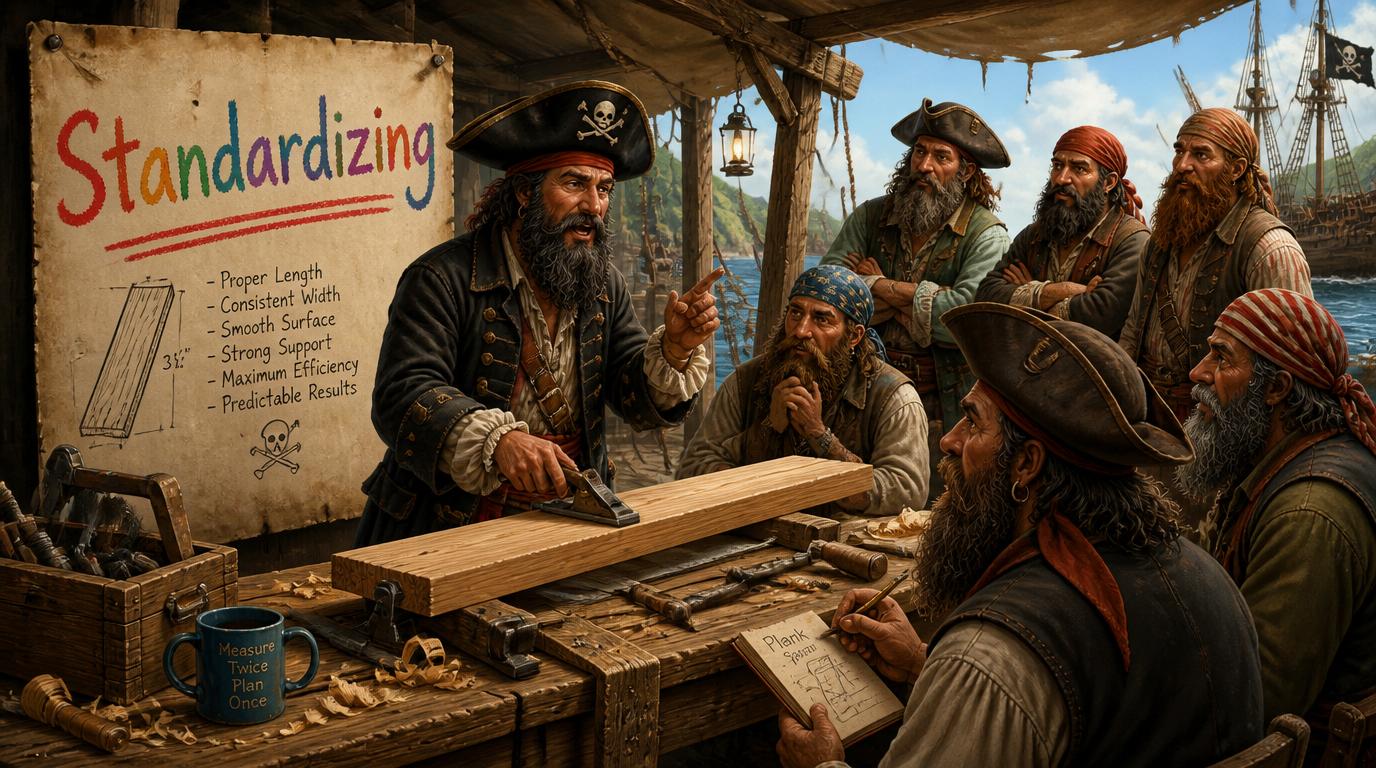
We then ran a training on how to build your own agents. As a very serious person, I of course gathered hundreds of people around the world and forced them to replicate my Market Like a Pirate agent or be forced to walk the plank. This training was, inevitably, rated “Arr”.
This silly little exercise resulted in those hundreds of people knowing how to build their own Plan & Execute agents with access to tools and knowledge. Six weeks later, our playing, sharing, and standardizing allowed a dramatic increase in participation and velocity. The collective “we” built over 750 agents in a month, with the most popular one running over a thousand times in that time period. If only I had a crayon for each time the agent runs…
Takeaway: Once you know what works, standardize to help everyone else get there. A talented person who masters their tool will outpace someone who kinda knows nine tools.
Step 4: Continuing (with all three)
OK this article is getting longer than a mountain man’s beard, so let’s pack in the last crayons so we can get back to our video games.
People thought the Internet changed things quickly, but AI is like a speed boat next to the Internet’s cruise ship. The velocity is astounding. That “rated arr” training I did? It was only a month ago and I already have to update it because the tool now supports AI skills. The concept is still the same, but that’s as powerful as adding an extra sail to the pirate ship.
Lest you get overwhelmed with the infinite changes, I recommend turning this framework into intentional phases. Spend a month encouraging people to play around with new tools and methods. Spend a couple of weeks sharing the coolest stuff. Spend a couple of weeks choosing what to standardize. Then spend a month getting people to use the new approach. If they don’t want to change, just take away all their crayons.
I do need to point out an easy way to accidentally run your ship aground. The temptation is to just follow with whatever is the current leader. But the current leader changes every couple of months in AI tools, so you’ll go from crayons to water colors to sculpting to blacksmithing to paint splattering and wonder why no one’s at the fountain with you.
Features aren’t unique anymore. Most of the major tools will catch up to the leader within a month or two. Channel your bearded Jedi wisdom here and tell people, “Patience, young padawan.” The dark side of AI adoption is chasing every shiny new lightsaber.
With some strategic patience, you can add some new crayons to your box instead of asking people to suddenly wield hammers and the flames of a forge. Now if you’ll excuse me, I have to go color in some pictures of mustachioed villains with my crayons.
Takeaway: Develop a rhythm of intentional times for creativity, sharing, and standardization. The pirate ship needs a steady heading, not a new captain (or new ship!) every two months.